Client
Club17 Curaçao
Overview
Stichting Club17 Curaçao works towards a sustainable and fair Curaçao and wanted to involve UoC students in that ambition through their SDG Journey. During the research the question turned out to sit one step earlier. Students I spoke with didn't need more knowledge about sustainability, they needed room to look at their own future first. Many of them carry pressure from study, work and family, and experience the island as a place with limited opportunities. That leaves little space to stop and think about personal growth, values and the choices ahead. As one student put it: "The importance of creating opportunities for yourself." From there the design question became: how can we help UoC students explore choices, limitations and consequences more consciously through recognisable situations, so they develop ownership over their future step by step?
Client
Club17 Curaçao
Industry
Education
Service
UI / UX Design
Graphic Design
Co-Design
App Development
Game Design
Duration
5 months


The Challenge
This was my graduation project at Club17, and I carried it end to end as design engineer. Researcher: field research, interviews and observations at the university to understand what students actually run into. Concept & game designer: the rules, the resource economy, the persona system and the balance between playing and reflecting. UX/UI designer: the full screen flow of the digital layer, from setup to final reflection. Visual designer & producer: the identity, the illustrations, the cards, tokens, badges, manual and packaging and the physical production of it all. Facilitator: I ran the playtests and the co-design sessions myself. The hardest part of the role was not designing a game, but keeping a game that stays fun while it asks people something serious.

The Solution
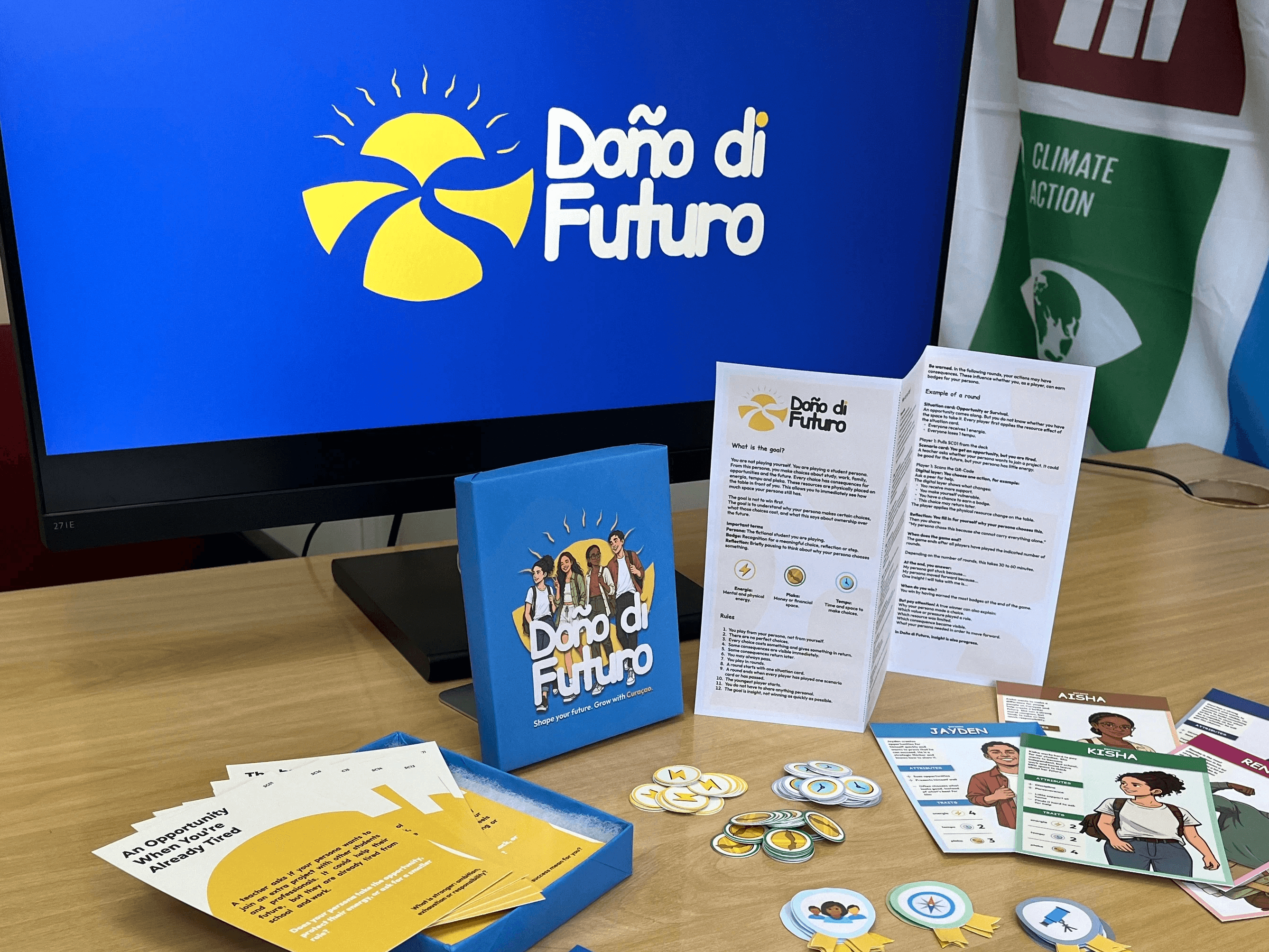
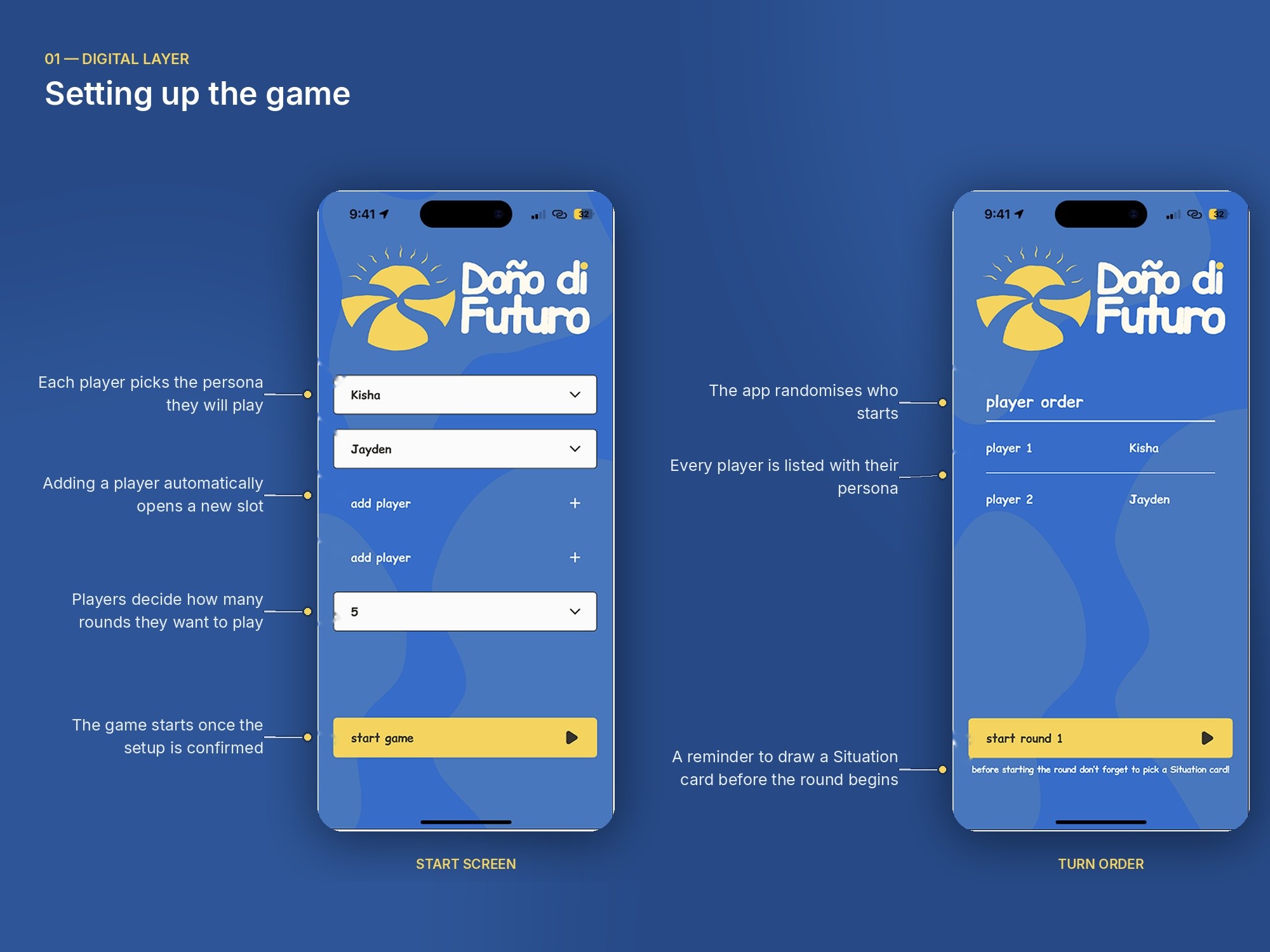
I built the game on Self-Determination Theory and translated autonomy, competence and relatedness into three concrete mechanisms: make choices visible, make consequences tangible, and make reflection safe through a persona. Players don't answer for themselves they answer for Kisha, Jayden, Dàvi, Rensley or Aisha, and spend energia, tempu and plaka to do it. That distance is what makes an honest conversation possible. The concept was developed with the target group through co-design sessions, paper prototypes and an MVP playtest, and iterated after every round. Delivered: a physical set of five personas, resource tokens, five badges, situation cards, scenario cards, a rulebook and packaging, plus a digital layer that carries the flow. Scenario cards open the right scenario through a QR or SC-code, the app handles actions, consequences, resources and badges, and closes with a reflection question per persona. Two to six players, 30–60 minutes, from 14 years up.

The Result
The MVP test showed the translation works. Players said the game made them more aware of their choices and the consequences that follow. One participant noticed that the same scenario can land completely differently depending on the persona you play. Another said the game helped them look further ahead than today. The strongest signal wasn't in the answers though it was that everyone wanted to play again. They wanted to try other choices and see if they could beat the facilitator. That's ownership showing up as behaviour instead of as a topic: players used what happened last round to choose differently in the next one. For Club17 that makes Doño di Futuro a realistic first step in the SDG Journey. Not a game about sustainability, but the foundation underneath it personal growth, decision-making and ownership.

The Transfer
Designing a semi-digital system taught me to be strict about which layer does what. The cards create the conversation, the app carries the bookkeeping the moment those two start competing, the game slows down. I also learned how much a persona does as a design tool: it lowers the threshold to say something honest, and it makes reflection something you do together instead of something you're put on the spot for. What I'd do differently is the reflection itself. The questions were there, but players only picked them up properly after a few rounds first they needed grip on the game. Next iteration I would make the reflection moments shorter, more visible and woven into the round instead of placed at the end of it. Not more reflection. Better timed.


PORTFOLIO

StartHub
StartHub
StartHub
UI / UX Design
App Design
Co-Design

Woodymas
Woodymas
Woodymas
UX/UI Design
Web Design
Web Development